NVIDIA Driver 596.49 vs 617.42 vs 621.01 Benchmark
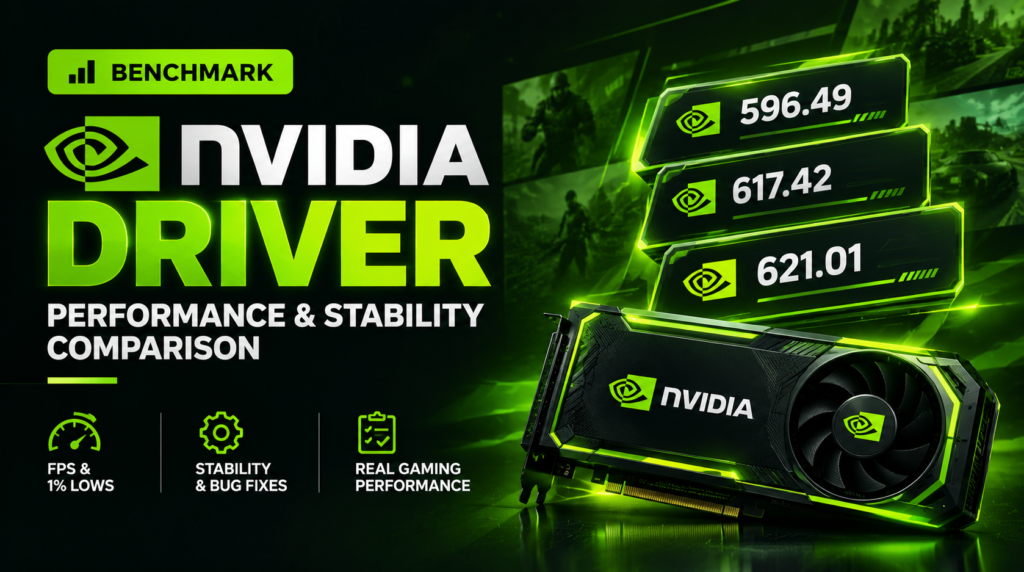
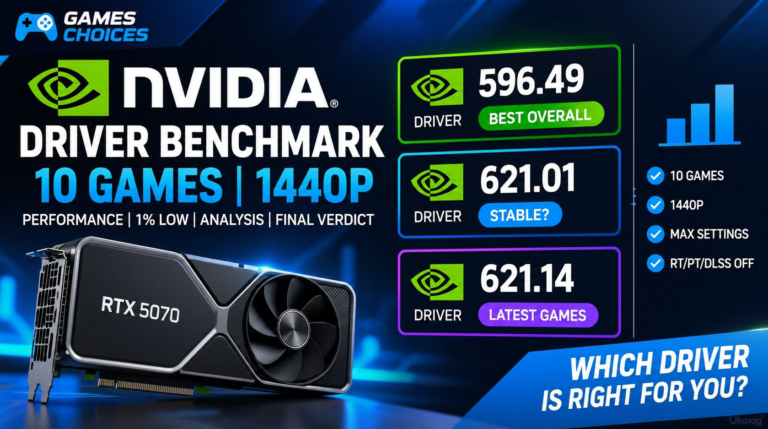
NVIDIA driver updates do not always mean more FPS, and with so many 600-series releases, it is hard to know which one to trust. So we tested the new 621.01 against 617.42 and the long-running 596.49 on an RTX 5070, across 10 games at 1440p with maxed-out settings.
The short version: the performance gap is small. On average, 621.01 is about 0.6% faster than 617.42 and roughly 1% behind 596.49. In our experience, though, 621.01 is one of the more stable drivers we have used recently. Here are the full results.
Test Setup
All tests were run on the same PC, with only the NVIDIA driver changed between runs. We turned off Ray Tracing, Path Tracing and DLSS on purpose, so the results show raw driver and GPU performance without upscaling or other features affecting the numbers.
PC Specifications
| Component | Details |
|---|---|
| CPU | AMD Ryzen 5 7500F |
| Motherboard | ASUS TUF Gaming X670E-Plus WiFi |
| RAM | XPG Lancer Blade RGB DDR5-6000 32GB CL30 |
| GPU | ZOTAC RTX 5070 Solid OC 12GB |
| CPU Cooler | ID-Cooling FX360 INF 360mm ARGB AIO |
| Storage | XPG Gammix S70 Blade 2TB PCIe Gen4 NVMe |
| PSU | Leadex VII Platinum PRO 1000W ATX 3.1 |
| Case | DarkFlash DK431 |
| OS | Windows 11 Pro 25H2 (64-bit) |
| Resizable BAR | Enabled |
Test Settings
- Drivers tested: NVIDIA 596.49, 617.42 and 621.01
- Resolution: 1440p
- Graphics preset: Max settings in all games
- Ray Tracing, Path Tracing, DLSS: Off
- Games tested: 10
- Recording: NVIDIA App
- Monitoring: MSI Afterburner (FPS, 1% lows, frame time, temperatures, clocks)
All results come from the RTX 5070. Other RTX 50 Series cards may show a similar trend, but we have not tested them.
NVIDIA Driver Benchmark Results 10 Games
We tested all three NVIDIA drivers on the RTX 5070 at 1440p using maximum graphics settings, with Ray Tracing, Path Tracing and DLSS disabled. Each driver was clean-installed using DDU, and the same test scenes and settings were used to keep the comparison consistent.
The table below compares average FPS and 1% lows across all 10 games. These results focus on raw performance, without upscaling or ray-tracing features affecting the results.
Overall Performance and 1% Low Analysis
Across our 10-game benchmark, NVIDIA driver 596.49 delivered the strongest overall raw performance, while driver 621.01 came very close behind. On average, 621.01 was approximately 0.6% faster than 617.42 and around 1% slower than 596.49.
Although these differences are relatively small, they help identify which driver performed best in our testing. Average FPS shows overall performance, while 1% lows help indicate how consistently a game runs during demanding moments.
We will compare the overall averages and 1% lows across all three drivers to see whether the newer releases offer any meaningful performance improvement over the older 596.49 driver.
Key findings:
- NVIDIA 596.49: Best overall raw performance in our testing.
- NVIDIA 621.01: Very close to 596.49 and faster than 617.42 on average.
- NVIDIA 617.42: Slightly behind 621.01 in average FPS.
These findings apply to our RTX 5070 test system. Results may vary with other GPUs, games and system configurations.
Which NVIDIA Driver Should You Use?
Choosing the right NVIDIA driver depends on whether you prioritize raw gaming performance or prefer a newer release with stability improvements.
NVIDIA 596.49 Best for Raw Performance
In our 10-game benchmark, driver 596.49 delivered the best overall raw performance on the RTX 5070. If your priority is getting the highest average FPS from this comparison, it remains our performance winner.
NVIDIA 621.01 Best Newer Alternative
Driver 621.01 performed approximately 0.6% better than 617.42 and stayed around 1% behind 596.49. Based on our experience, it is also a strong contender for stability among recent NVIDIA drivers.
For users who prefer a newer driver without giving up much raw performance, 621.01 is worth considering.
NVIDIA 617.42 Still a Comparison Point
Driver 617.42 delivered slightly lower average FPS than 621.01 in our testing. However, the difference was small, so your experience may vary depending on the games you play and your system configuration.
Our recommendation: Choose 596.49 if raw performance is your main priority in these tested games. Consider 621.01 if you prefer a newer release and have experienced better stability with it. Always test a driver with your own games before deciding which one to keep.
Final Verdict
Our 10-game benchmark shows that older NVIDIA drivers can still deliver competitive gaming performance. On our RTX 5070, driver 596.49 achieved the best overall raw performance, while newer driver 621.01 came close, averaging around 1% lower FPS.
Driver 621.01 was also approximately 0.6% faster than 617.42 in our tests. Based on our experience, it is a promising newer option for gamers looking for a balance between performance and stability.
Our final recommendation: Stick with NVIDIA 596.49 if you want the best raw performance from these three drivers in our tested games. If you prefer a newer release, consider 621.01 and check how it performs with your own games and system.
Keep in mind that these results are based on one RTX 5070 system at 1440p with maximum graphics settings and Ray Tracing, Path Tracing and DLSS disabled. Performance and stability can vary across GPUs, games and PC configurations.
Watch the Full Benchmark
Watch our YouTube video for the gameplay footage and direct performance comparison of all three NVIDIA drivers.
For more details and related NVIDIA driver information, check out our previous article.
Read Our Related Information Post
Related Article: NVIDIA Game Ready Driver 621.01 Released
If you found this benchmark useful, share your experience in the comments. Which NVIDIA driver are you currently using, and have you noticed any differences in performance or stability?