NVIDIA Driver 596.49 vs 621.01 vs 621.14 Benchmark
NVIDIA 596.49 vs 621.01 vs 621.14 Driver Benchmark: Which Performs Best?
A newer NVIDIA driver doesn’t always mean better gaming performance. Sometimes, an older release can deliver better FPS, smoother gameplay, and more consistent performance than the latest update.
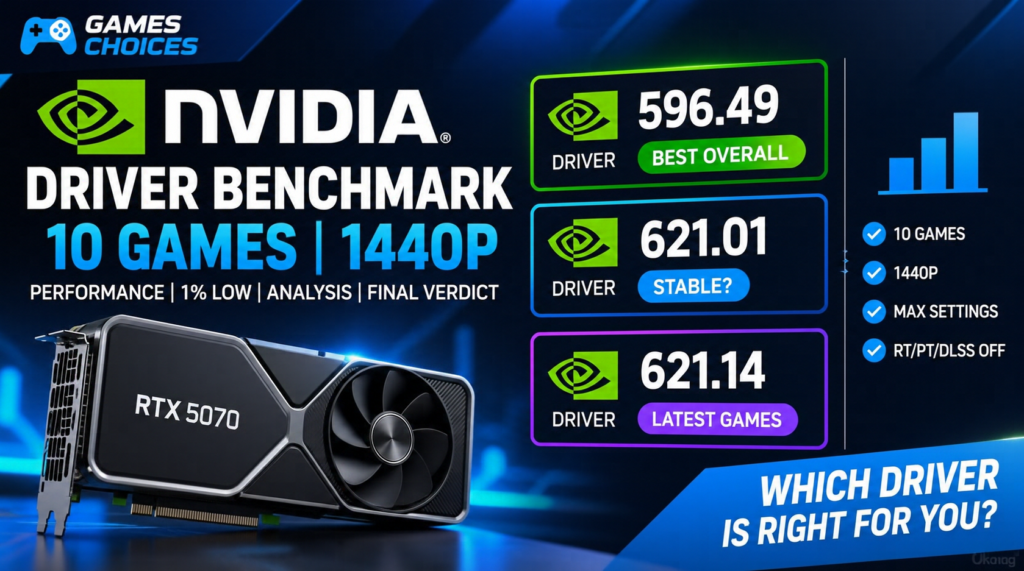
That’s exactly what we wanted to investigate in this benchmark. We tested three NVIDIA GeForce drivers 596.49, 621.01, and the latest 621.14 on the same RTX 5070 system across 10 games at 1440p resolution.
The comparison includes popular titles such as Cyberpunk 2077, The Last of Us Part II, Ghost of Tsushima, Crimson Desert, Resident Evil Requiem, and more. We recorded both Average FPS and 1% Low results to compare overall performance and frame-time consistency.
But raw performance isn’t the only thing that matters. Driver stability, compatibility, and support for newer games are also important when deciding which version to install.
So, does the latest 621.14 driver finally outperform the older 596.49, or is the older release still the better all-round choice?
Test Setup
All three drivers were tested on the same PC using identical settings and gameplay scenes.
PC Specifications
| Component | Details |
|---|---|
| CPU | Ryzen 5 7500F |
| Motherboard | ASUS TUF X670E-Plus WiFi |
| GPU | ZOTAC RTX 5070 Solid OC 12GB |
| RAM | XPG Lancer Blade DDR5-6000 32GB |
| Storage | XPG S70 Blade 2TB NVMe |
| PSU | Leadex VII 1000W |
| OS | Windows 11 Pro 25H2 |
Benchmark Settings: 1440p, Maximum Graphics Settings, RT/PT/DLSS Off (Raw Performance), DDU Clean Driver Installation.
All results include Average FPS and 1% Low measurements.
NVIDIA Driver Benchmark Results: 10 Games
We tested NVIDIA drivers 596.49, 621.01, and 621.14 across 10 games at 1440p using maximum graphics settings. All tests were performed with RT/PT/DLSS disabled to measure raw GPU performance.
The following charts compare Average FPS and 1% Low performance across all three drivers. This makes it easier to identify which driver delivers higher FPS and better consistency in different games.
Next, let’s look at the Average FPS results first.
Average FPS Comparison
The Average FPS results show that NVIDIA driver 596.49 leads in several games, while 621.01 and 621.14 deliver similar performance in most titles. CONTROL Resonant is the only game where 621.14 takes the lead.
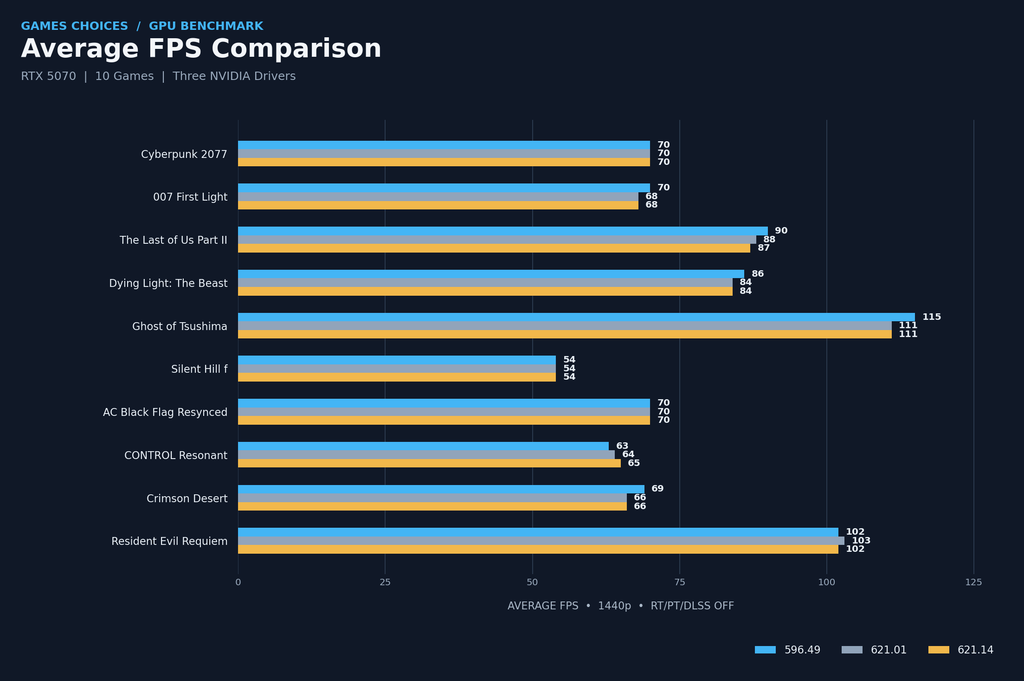
596.49 delivers the highest Average FPS in most of these tests. The differences are generally small, but the older driver maintains a consistent lead across several demanding games.
1% Low FPS Comparison
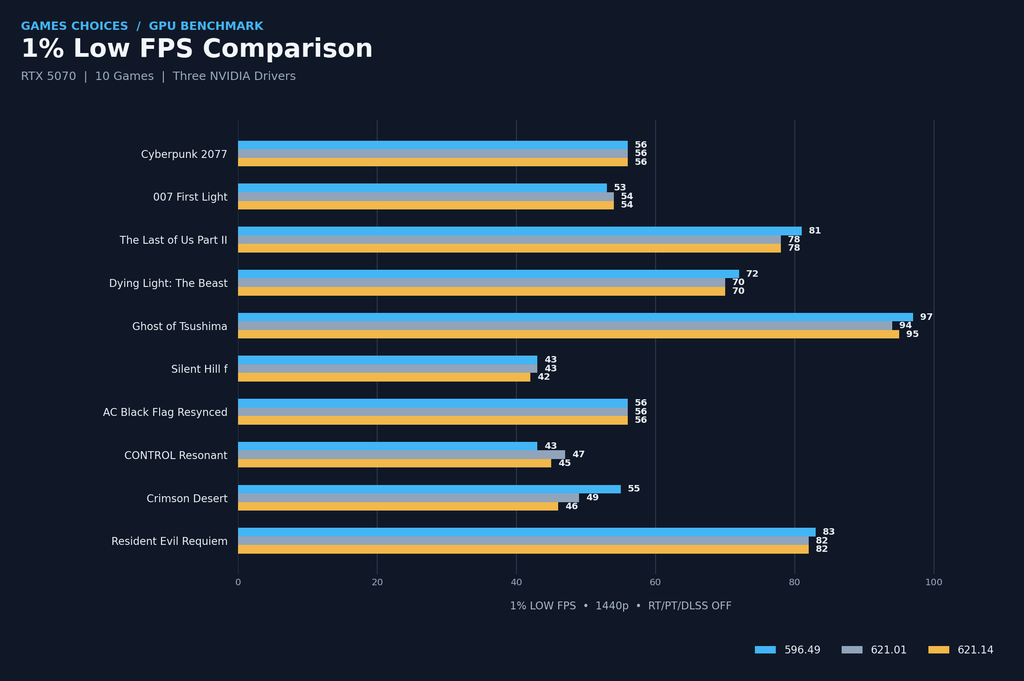
Driver 596.49 delivers stronger 1% Low FPS in several games, particularly The Last of Us Part II, Ghost of Tsushima, and Crimson Desert. However, 621.01 performs better in CONTROL Resonant and matches or slightly exceeds 596.49 in 007 First Light.
Overall Performance Analysis
Across all 10 games, NVIDIA driver 596.49 delivers the strongest overall performance on our RTX 5070 test system, although the differences between the three drivers are relatively small.
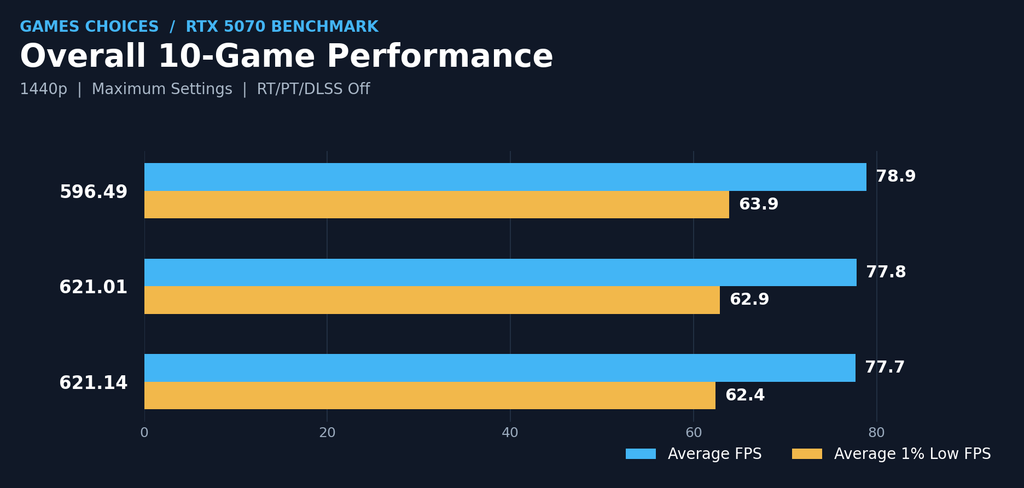
10-game arithmetic averages, calculated from our benchmark results.
Driver 596.49 leads 621.01 by approximately 1.4% and 621.14 by 1.5% in Average FPS. It also delivers slightly better overall 1% Low results.
The biggest differences appear in Ghost of Tsushima, Crimson Desert, and The Last of Us Part II, where the older driver maintains a small advantage. Meanwhile, CONTROL Resonant performs better on 621.14, while Cyberpunk 2077 and Assassin’s Creed Black Flag Resynced show identical Average FPS across all three drivers.
These results suggest that upgrading to the latest NVIDIA driver does not necessarily improve raw gaming performance. However, newer drivers may still offer important game compatibility improvements and bug fixes that are not reflected in FPS benchmarks alone.
Which NVIDIA Driver Should You Install?
NVIDIA 596.49: Best Overall Performance
Based on our benchmarks and testing experience, driver 596.49 remains our preferred all-rounder. It delivers the highest overall Average FPS and 1% Low results on the RTX 5070. In our experience, it has also been a reliable choice across older GTX and newer RTX GPUs, including the RTX 50 Series.
NVIDIA 621.01: Decent Performance, but Stability Concerns
Driver 621.01 delivers competitive gaming performance, with only minor FPS differences compared to 596.49. However, reported video playback freezes and black-screen issues make it a less attractive option, particularly for affected RTX 50 Series users.
NVIDIA 621.14: Better Choice for Latest Games
Driver 621.14 delivers nearly identical gaming performance to 621.01 in our tests. While it does not outperform 596.49 overall, it offers newer game support and addresses certain video playback freezing and black-screen issues affecting RTX 50 Series GPUs.
Our Recommendation: Stick with 596.49 if your games are running smoothly and raw performance is your priority. For players who need the latest game support or fixes for known issues, 621.14 is the more practical choice.
Final Verdict
After testing all three NVIDIA drivers across 10 games at 1440p, 596.49 comes out on top, delivering the highest overall Average FPS and 1% Low performance on our RTX 5070.
Although the performance differences are relatively small, 596.49 remains our favorite all-rounder based on our testing experience across GTX and RTX graphics cards.
However, 621.14 is the better option for players who prioritize the latest game support and driver fixes. It delivers performance similar to 621.01 while addressing certain reported issues.
Ultimately, if 596.49 is running smoothly on your system, there’s no need to rush into an update. But if you’re experiencing compatibility problems or playing newly released games, 621.14 is worth considering.
Watch the Full NVIDIA Driver Benchmark
Want to see the actual gameplay performance? Watch our full YouTube benchmark comparing NVIDIA drivers 596.49, 621.01, and 621.14 across 10 games on the RTX 5070.
Which NVIDIA driver are you currently using? Share your gaming performance and stability experience in the comments.